REVIEW · ROME
Vespa Tour – The Essence of Rome
Book on Viator →Operated by Rome for You Soc. coop · Bookable on Viator
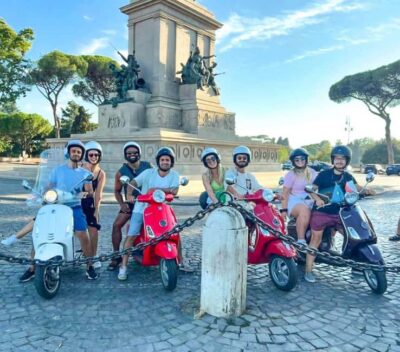
Rome on a Vespa feels like cheating. You get a fast, street-level sweep of major landmarks with a professional guide and Vespa + helmet included. I like that you can often cover more ground than on foot, and that the guide keeps stopping for photo moments while explaining what you’re actually looking at (Marco and Victorio come up a lot in the guide stories).
The trade-off is real: this is not a slow walking tour. You need strong scooter driving skills for tight streets and heavy city traffic, and the stops are short, so it is not the best plan if your goal is to go inside every single site.
In This Review
- Key things to know before you ride
- Why Rome is better when you travel by scooter
- Meeting up, licences, and what you need for the ride
- Safety and driving reality in Roman traffic
- Price and what you actually get for $137.80
- Area Sacra di Largo Argentina: the start point with big contrasts
- Foro Romano and the Colosseum: a fast, guided path through the core
- Circo Massimo and the Mouth of Truth area: Rome’s spectacle side
- Piazza Venezia to Trevi Fountain: monuments to throw coins at
- Spanish Steps and the Pantheon: stairway drama and Roman engineering
- Piazza Navona: fountains, churches, and a good last look around
- Castel Sant’Angelo and St. Peter’s Square: two Rome icons in one push
- Campo de’ Fiori: end with street life and small-scale Rome
- Who should book this Vespa tour, and who should skip it
- Should you book the Vespa Tour – The Essence of Rome?
- FAQ
- How long is the Vespa Tour – The Essence of Rome?
- What is included in the price of $137.80 per person?
- Is the tour offered in English?
- Do I need a driver’s license to ride?
- What is the minimum age?
- How many people are on a booking?
- Where does the tour start and end?
Key things to know before you ride
- Vespa setup included: you get the scooter, a helmet, and fuel, which is a big part of the value for a 3-hour tour
- Small groups, private tour: max 10 people per booking, and it is only your group
- Real traffic skills required: this is for riders who are comfortable in Roman city streets
- Short stops, big overview: you skim many landmarks with guidance instead of slow ticket lines
- Outside viewing is the rhythm: some major attractions are described more than entered, based on what is marked as not included
- Your language is set: the tour runs in English
Why Rome is better when you travel by scooter
Rome looks different when you move at scooter speed. You still get the famous landmarks, but you also get the in-between streets, the quick turns, and the way the city’s layout reveals itself when you are not stuck in a long line of pedestrians.
What I like most is the mix of iconic sights and street feel. You’re not just parked in front of monuments; you’re learning how places connect, then watching that story play out as you ride from area to area. The guides also focus on what you can see from the road, which makes the whole thing feel practical.
You should also think of this as a best-of Rome primer. It is a quick “get your bearings fast” experience, not a deep museum day. If you already know you want long interior visits, plan those separately.
Meeting up, licences, and what you need for the ride
You will meet at the location the tour lists for the scooter rental: BigaBike – Rent Scooter Rome, Via di S. Calisto, 9, 00153 Roma RM. The tour day pickup guidance also references meeting at Vicolo di San Nicola dè Cesarini, 4, so I recommend treating that as your key reference point for where the guide will find you.
Bring your B driver’s license. For US citizens, you will need an International Driving Permit as the tour requires a B license, not just a regular US card. If you do not have that paperwork ready, this is the kind of thing that can stop you before you even start.
Plan your outfit as smart casual. You’ll be on a scooter for a few hours, so comfortable shoes matter, even if the dress code is not formal. The tour also specifies a minimum age of 21, and you can choose to ride one or two riders per scooter, depending on the setup that day.
One more detail that helps: your ticket is mobile, and you’ll get confirmation when you book. For a popular Rome activity with an average booking window of about 28 days in advance, earlier planning gives you more choice.
Safety and driving reality in Roman traffic
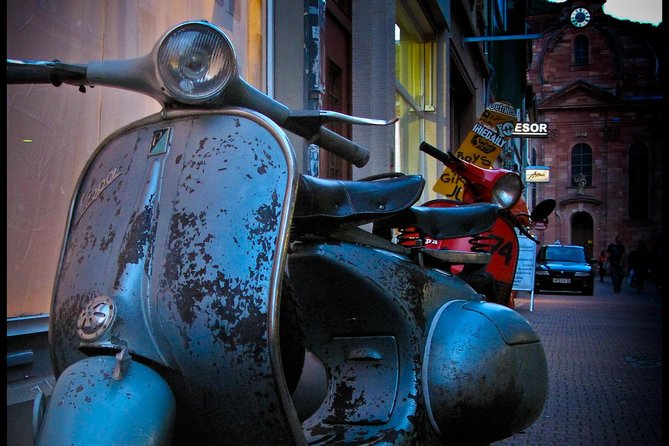
This tour is not for the faint-hearted, and the requirement is straightforward: strong experience riding scooters in city traffic conditions. Roman traffic is close, fast, and full of unpredictable turns, so the tour expects you to handle that comfortably before the first stop.
The good news is that the guides manage the group pace. In guide stories, Marco is described as riding slow to keep everyone together, and pulling over when needed. Victorio also becomes part of the fun, including the kind of light, playful energy that helps you stay calm while threading through busy roads.
Still, you should be honest with yourself here. If you feel tense when riding in tight lanes or you get shaky at quick merges, you may not enjoy this. For many people, the biggest stress is not the ride itself, but the feeling of being behind or squeezed while you try to keep control.
Price and what you actually get for $137.80
At $137.80 per person for about 3 hours, the value is mostly in what’s bundled. You are paying for the Vespa, helmet, and fuel, plus a professional guide who coordinates the route and explains what you’re seeing.
What is not included is also clear. Food and drinks are not included unless specified, and major sites you might want to enter (like Foro Romano and the Colosseum) are marked as not included for admission. Other areas are marked as free, which usually fits with the outside-sightway style of this kind of ride.
In plain terms: this is a “pay for motion + guidance” deal. If you were going to rent a scooter anyway and pay for a guide for a short, targeted day, it can feel like a smart shortcut. If you want to spend lots of time going inside buildings, the short stop times may reduce how much you personally get from what you pay.
Area Sacra di Largo Argentina: the start point with big contrasts
You kick off in the Largo Argentina area, specifically near Area Sacra di Largo Argentina. This is a strong way to begin because it sets the tone: Rome is layered. You’re in the middle of modern street life, but the guide points you toward the ancient footprint under and around it.
Even though your time here is about 10 minutes, the point is to orient your brain. Your guide frames what this part of Rome represents, so the rest of the landmarks you hit later feel connected rather than random dots on a map.
A possible drawback is the same one you’ll feel all day. Ten minutes goes quickly when you are also learning traffic flow and getting used to your scooter. If you need a slow, quiet ramp-up, you may have to reset mentally after you get moving.
Foro Romano and the Colosseum: a fast, guided path through the core
Next come two of the most important names in Rome: Foro Romano and the Colosseum (Flavian Amphitheatre). The guide uses these stops to explain the “heart” of Ancient Rome and the major context around how the empire projected power.
At Foro Romano, your time is about 10 minutes, and admission is marked as not included. That means you’re not counting on this stop to be an all-access visit. Instead, you’re looking at the scale and hearing the story the guide ties to what you can see nearby.
Then it’s the Colosseum, again about 10 minutes, with the guide bringing in details like its role as a symbol of Imperial Rome and mention of the Arch of Constantine. It’s a classic moment, even from outside or with limited viewing time, because the guide helps you connect the monument to what it meant in its original setting.
If you love photos and you want them to be purposeful, this portion works well. But if you came to Rome planning to spend hours inside the Colosseum galleries, you’ll want a separate ticket day.
Circo Massimo and the Mouth of Truth area: Rome’s spectacle side
The route then shifts to Circo Massimo, the ancient chariot racing stadium, with views toward Palatine Hill. This is a smart change of pace because it feels less like “one giant building” and more like a whole system of ancient Rome in action.
Your stop here is about 10 minutes, and admission is marked as free. In practice, that usually means you get explanations tied to what you can see and where the space would have mattered for spectators and events.
After that, you hit the bell tower area associated with the Mouth of Truth. The tour points out that this bell tower is the tallest medieval belfry in Rome and houses the Mouth of Truth, plus nearby Temple of Hercules Victor and Temple of Portunus across the street.
This is the kind of stop that feels fun without being shallow. You get the landmark story, then you get the street view context that helps you understand why these places were built where they were.
Piazza Venezia to Trevi Fountain: monuments to throw coins at
Piazza Venezia is next, with a cluster of major sights in a short span. The guide covers Trajan’s Column, the Vittoriano monument, Altare della Patria (Italy’s Tomb of the Unknown Soldier), Capitoline Hill, Church of Saint Mark, and Palazzo Venezia. Your time is about 10 minutes and admission is marked as free.
This stop works because it compresses Rome’s political and ceremonial identity into one sweep. You do not need to read a textbook to understand the vibe; you stand in the right spot and your guide connects symbols and eras.
From there you go to Fontana di Trevi. This is 15 minutes, free admission, and it’s where the tour leans into the classic ritual: toss a coin over your shoulder to help ensure you come back to the Eternal City one day.
Trevi is famous for a reason, but I like how the guide keeps it tied to the architecture and story instead of only the crowd photography. The practical tip: treat it as your photo anchor, then keep your eyes open for what your guide points out beyond the postcard angle.
Spanish Steps and the Pantheon: stairway drama and Roman engineering
The Spanish Steps take about 15 minutes. The guide highlights the Scalinata di Trinità dei Monti, plus the Church of the Santissima Trinità dei Monti, the early Baroque fountain Fontana della Barcaccia, and the Column of the Immaculate Conception.
This stop can be a favorite because you feel the difference between Rome as traffic and Rome as stage. The steps are big and theatrical, and you get time to appreciate the structure before you move on.
Then comes the Pantheon for about 10 minutes. The tour description calls out that the guide provides the full history and architectural description of the Pantheon, and admission is marked as free. That matters because architecture is the kind of thing you can miss if you just rush through it on foot.
So even in a short time, the guide gives you enough context to notice the details you’d otherwise overlook. If you are the type who likes to understand how a building works, this is a strong moment.
Piazza Navona: fountains, churches, and a good last look around
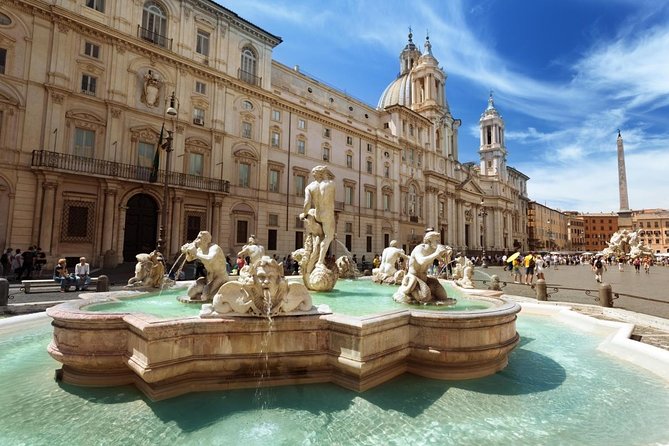
Piazza Navona is about 15 minutes and stays marked as free. Your guide shows you the plaza features, including the Fountain of the Four Rivers, the church of Sant’Agnese in Agone, the Fountain of Neptune, and the Moor Fountain.
This stop has a different feel from Trevi and the Pantheon. It’s more about space and atmosphere, and it gives you a chance to compare how different eras used public squares. Even with time pressure, you can still see how the layout invites strolling and lingering.
A quick practical point: this is a popular area, and you’re going to share sight lines with other people in the public space. The tour keeps it organized by giving you a path to follow and an explanation per landmark.
Castel Sant’Angelo and St. Peter’s Square: two Rome icons in one push
You then approach Castel Sant’Angelo. The tour offers outside viewing of the mausoleum of Hadrian, along with Ponte Sant’Angelo lined with ten angel sculptures. Time is about 10 minutes, free admission.
This part works well after Piazza Navona because it shifts your attention from city life to a river-crossing monument story. The guide helps you see why this area mattered and how it links to other parts of Rome’s timeline.
Next is St. Peter’s Square for about 15 minutes, again free. Your guide explains St Peter’s Basilica and covers the square itself, including the obelisk and Bernini’s Colonnades. The tour does not promise long interior time, but it gives you the big, defining view.
Even if you’ve seen photos before, getting the scale in person helps. And because you’re moving by scooter through the city, you get that sense of how all these sites sit inside one living, working place.
Campo de’ Fiori: end with street life and small-scale Rome
You finish at Campo de’ Fiori, with about 15 minutes of strolling through the daily market. This is a nice ending because it lets you land back in local rhythm rather than staying locked on monuments.
Your guide keeps the final stretch grounded in everyday Rome. It’s the kind of stop that helps you transition from “tour mode” to “wander mode” on your own.
Since the activity ends back at the meeting point, you’ll want to keep a little energy for the last walk. Think of this as a gentle landing rather than the grand finale.
Who should book this Vespa tour, and who should skip it
Book this if you want a short, high-impact Rome overview and you like learning on the move. If your travel style is about getting street-level context, building a mental map fast, and taking great photos from well-chosen stops, this tour matches that.
It’s also a good fit for first-time Rome visits. The route hits major anchors like Largo Argentina, the Colosseum area, Trevi, the Pantheon, and St. Peter’s Square, with enough explanations to help everything click.
Skip it if you cannot ride confidently in traffic. The requirement is strong for a reason. Also skip it if your priority is long, inside-the-building time at every major site, because the stops are measured in minutes.
If you want a plan that balances this tour with deeper time elsewhere, do it like this: use the Vespa day to decide what you want to revisit by foot or with timed entry later.
Should you book the Vespa Tour – The Essence of Rome?
Yes, I’d book it if you meet the riding requirements and you like guided momentum. The big value is practical: you get the scooter and fuel included, a professional guide shaping your view, and a route that covers a lot of Rome without dragging you through slow queues.
But I would not book it if scooter traffic makes you uneasy. Even with patient guiding and slow pacing, the experience still asks you to handle the ride. If you want comfort first and you plan to spend hours inside major sites, you might get better satisfaction with a walking tour plus separate ticket visits.
If you do ride, you’ll come away with a faster mental map of Rome and a sense of how the city connects across centuries. That alone can make the rest of your trip feel easier to navigate.
FAQ
How long is the Vespa Tour – The Essence of Rome?
It lasts about 3 hours.
What is included in the price of $137.80 per person?
The tour includes use of the Vespa, helmets, and fuel, plus a professional guide.
Is the tour offered in English?
Yes, it is offered in English.
Do I need a driver’s license to ride?
Yes. A B driver’s license is required, and US citizens need an International Driving Permit.
What is the minimum age?
The minimum age is 21.
How many people are on a booking?
The tour is limited to a maximum of 10 people per booking, and it’s a private tour for your group.
Where does the tour start and end?
The tour starts at BigaBike – Rent Scooter Rome (Via di S. Calisto, 9) and ends back at the meeting point.