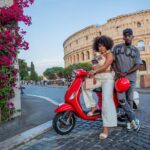
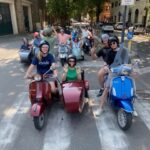
Rome at night feels like a movie scene. This Vespa sidecar tour pairs iconic monuments with a guide’s headset commentary, so you get history without stopping the fun. I also like the fact that the ride is built around short, timed photo-and-look stops, not long waits.
One thing to consider: you’ll be on a scooter for the whole 3 hours, so it’s not ideal if you dislike street noise, bumps, or the idea of riding seated in a sidecar.
In This Review
- Key highlights you’ll actually feel on the ride
- A 3-hour Vespa sidecar night tour: what it’s like when the lights come on
- Price and what you get for $181.41: value beyond the scooter photo
- Meeting at Piazza della Repubblica: helmets, headsets, and who sits where
- Stop 1: Piazza della Repubblica and what to notice before you speed off
- Stop 2: Quirinale Palace and Rome’s power backdrop
- Piazza Venezia and the Victor Emmanuel monument: what you’ll learn in minutes
- Pantheon stop: seeing the old Rome masterwork (without entering)
- Trevi Fountain and the Spanish Steps: quick stops that still feel worth it
- Piazza del Popolo and St. Peter’s Square: two Rome entrances at night
- Terrazza del Gianicolo: when you want a breather from the crowds
- The neighborhood drive: alleys, trattorias, and the Jewish Ghetto passing-by
- Santa Maria Maggiore stop: a major basilica you’ll recognize later
- Vico Pizza&Wine: gourmet pizza tasting with wine (and the gluten-free detail)
- The guide and drivers: why headsets and local navigation matter
- Weather, pacing, and your comfort level on cobblestones
- Who should book this Vespa sidecar tour (and who should skip it)
- Should you book this evening Vespa sidecar tour?
- FAQ
- What time does the tour start?
- How long is the tour?
- Where does the tour begin and end?
- Is the Pantheon included?
- What’s included in the pizza stop?
- Is gluten-free pizza available for celiac disease?
- How many people are on the tour?
- Can children ride on the sidecar or back seat?
- Are there any rider restrictions?
- What if the weather is bad?
Key highlights you’ll actually feel on the ride
- Live, interactive narration with headsets so you can hear the guide clearly through Rome traffic
- Professional drivers handling the driving, while you focus on the sights
- Tight stops at major landmarks for quick photo time and close-up viewing
- CE helmets with sterilized disposable head covers for peace of mind
- Pizza tasting dinner at Vico Pizza&Wine with wine included
- Small group size (max 12) for a more personal pace at night
A 3-hour Vespa sidecar night tour: what it’s like when the lights come on
The best part of this tour is how quickly you can switch gears from walking Rome in daylight to experiencing it after dark. You’ll see big hitters like the Pantheon area, Trevi Fountain, Piazza del Popolo, and St. Peter’s Square as the streets quiet down and the monuments look sharper under evening lighting.
The format is simple: sit back, get your headset adjusted, and let the guide do the talking while the driver threads Rome’s lanes. Because it’s set up for sidecars, it also changes your vantage point. You’re not just looking at buildings from street level; you’re riding past them, which makes the city feel more connected.
And yes, the “Roman by night” vibe is real. Even the brief stops feel like mini moments—enough time to look up, take photos, and hear what matters, then back on board.
Price and what you get for $181.41: value beyond the scooter photo
At $181.41 per person for about 3 hours, this isn’t a budget tour. But you are paying for a specific combo: transportation by Vespa sidecar, guide narration via headsets, and a planned dinner experience.
Here’s the value angle that matters for you:
- You’re covering multiple famous places in a single evening, with driving handled for you.
- You’re not doing “drive-by sightseeing.” The route includes designed stops so you can get closer to the landmarks.
- You’re also getting a gourmet pizza tasting with wine at Vico Pizza&Wine, so you’re not hunting for dinner after the tour.
So the question isn’t just whether it’s expensive. It’s whether you want to trade one slow evening of planning and navigation for a guided night that rolls from sight to sight, then feeds you.
Meeting at Piazza della Repubblica: helmets, headsets, and who sits where
You start at P.za della Repubblica, 41, 00185 Roma at 7:00 pm, and you return there at the end. The meeting point being near public transportation helps, because you can build the evening around it without stressing about getting across town late.
Before you roll, you’ll get set with:
- Homologated CE helmets plus sterilized disposable head covers
- Headsets so the guide’s narration stays clear
You also need to know the seating basics upfront. Each Vespa setup can carry two passengers: one in the sidecar and one behind the driver. If you booked one seat only, you’ll share the vehicle with another guest, and you may be able to swap seats during stops so everyone has a turn in the sidecar.
Weight and fit rules are taken seriously. The maximum weight for the passenger riding behind the driver is 118 kg / 260 lb, and the sidecar can hold up to 110 kg / 242 lb. The sidecar also has a height limit of 1.90 m. Children must be at least 5 years old, and seating rules depend on height (kids can seat behind the driver only if taller than 150 cm, otherwise they must sit in the sidecar).
If you’re tall, short, or traveling with kids, I’d check these limits early. It’s much easier to sort out before arrival than while you’re standing on the sidewalk at dusk.
Stop 1: Piazza della Repubblica and what to notice before you speed off
Your first stop is Piazza della Repubblica, an important square shaped by redevelopment after Rome became the Italian capital. It’s the kind of place that looks “modern Rome” until you catch the details, like the grand roundabout layout and the fountain Fontana delle Naiadi.
Look for the contrast: imposing buildings on one side and a more unfinished-looking temple structure on the other. That mix makes the square feel like a snapshot of Rome’s layers rather than a single time period.
The stop is about 10 minutes, so you’ll want to use it efficiently: photos first, then take a moment to orient yourself. From here, the ride really starts to feel like a curated route, not random driving.
Stop 2: Quirinale Palace and Rome’s power backdrop
Next you head to the Palazzo del Quirinale on Quirinal Hill. This isn’t just a pretty backdrop; it’s one of the three official residences of the President of the Italian Republic. The route also frames it in a classic Rome way—on a hill, in an area people call Monte Cavallo.
Your time here is short (about 5 minutes). That’s normal for this style of tour. The goal is to give you a quick sense of where you are in Rome’s political and historical geography, then move on while you’re still awake and energetic.
If you like architecture and institutional buildings, this stop gives you a different Rome flavor than the “postcard monuments” stops.
Piazza Venezia and the Victor Emmanuel monument: what you’ll learn in minutes
You also stop at Monumento Nazionale a Vittorio Emanuele II (the area around Piazza Venezia; often associated with the Altare della Patria). It was inaugurated in 1911 to honor Victor Emmanuel II after Italy’s unification.
What makes this stop interesting is that it’s more than a big white mass you pass by. The monument has an internal space connected to the history of the Risorgimento, plus a Central Museum of the Risorgimento. Since 1921, it also holds the tomb of the unknown soldier, with the eternal flame and guards present.
Even if you only get a small window, this is the kind of place where your guide can connect the architecture to the story—so you leave with context, not just pictures.
Pantheon stop: seeing the old Rome masterwork (without entering)
The route includes the Pantheon, one of the best-preserved ancient Rome buildings. It was completed around 126 AD and is known for its famous oculus, which lets natural light pour into the interior.
Important practical note: you won’t enter. The tour indicates the Pantheon will be closed during the tour, so you’ll only view it from the outside and keep moving. Admission isn’t included, and you’re not meant to plan a longer museum-style visit.
If your main goal is the exterior vibe and the stories behind it, this still works. If your dream is standing inside the Pantheon, you’ll need a separate daytime plan.
Trevi Fountain and the Spanish Steps: quick stops that still feel worth it
Trevi Fountain is on the route for about 30 minutes, and it’s the kind of stop where timing can matter. You’ll get a real look at the scale—roughly 20 meters wide by 26 meters high—and you can connect it to the aqueduct story: the fountain’s origins link to the Aqua Virgo aqueduct.
The background detail that helps you enjoy the fountain more: Trevi’s name comes from Tre Vie, meaning three streets meeting at that point. It’s one of those small “why it’s here” explanations that makes the stop feel smarter.
Then you’ll head to the Spanish Steps (Scalinata di Trinità dei Monti), connecting Piazza di Spagna to the Church of Trinità dei Monti. The steps are famous for views and for the casual rhythm—people sitting, resting, and watching the square energy.
If you’re traveling for photos, remember that this tour is built around short photo-and-look windows. Use Trevi and the Spanish Steps to grab your best angles fast, then move before crowds and fatigue take over.
Piazza del Popolo and St. Peter’s Square: two Rome entrances at night
Next comes Piazza del Popolo, at the northern gate area that used to be Porta Flaminia. Even at night, you can feel how important it was as a city entrance during Roman times. Three major streets radiate from here, including Via del Corso, one of Rome’s main thoroughfares.
The stop is brief (about 5 minutes), but it’s a good “orientation anchor” between the central sights and the Vatican side.
Then the route continues toward St. Peter’s Square (Piazza San Pietro) in Vatican City. This is one of the most famous squares on earth, and it’s tied to St. Peter’s Basilica. The tour experience here is more about the scale and the feeling of the space than about doing inside sightseeing.
The square can hold over 300,000 people, which gives you a clue why it feels so monumental even when you’re standing amid a smaller group.
Terrazza del Gianicolo: when you want a breather from the crowds
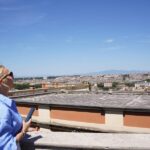
After the big icons, the route shifts to the calmer feel of Janiculum Hill (Terrazza del Gianicolo). It’s often called the “eighth hill” of Rome, and it sits just outside the ancient city center.
This stop is about 15 minutes, and it’s timed like a reset. You get pathways and sculptures connected to the defense of Rome, including references to Giuseppe Garibaldi. Most importantly, you get views.
If you’ve been in Rome’s sightseeing mode for a couple days already, this is where you can slow down. Take a moment to look back at the city and let everything you saw earlier click into place.
The neighborhood drive: alleys, trattorias, and the Jewish Ghetto passing-by
A key part of this tour isn’t just the famous landmarks. The route includes a drive through the authentic “soul of Rome” along narrow alleys and past typical trattorias.
You’ll also pass by the Jewish Ghetto area. This kind of moving neighborhood segment matters because it gives you texture. Rome can feel like a list of monuments if you only do big sights. This adds a sense of how real people move through the city.
This part also helps at night when streets feel more cinematic. You’re not stuck in one overcrowded spot; you’re traveling through Rome’s fabric.
Santa Maria Maggiore stop: a major basilica you’ll recognize later
The tour also includes Basilica di Santa Maria Maggiore, one of Rome’s four major basilicas and the largest dedicated to the Virgin Mary among the city’s churches of this type.
Even with a short stop, you’ll come away with the feel of the building, and the guide’s narration helps you place it in the larger map of Rome’s religious landmarks.
If you want a “bonus classic” beyond the headline names, this is a solid addition.
Vico Pizza&Wine: gourmet pizza tasting with wine (and the gluten-free detail)
The food stop is dinner/gourmet pizza tasting at Vico Pizza&Wine, and wine is included. This matters because it’s not a quick snack at the end. It’s part of why the whole tour works as a plan for your evening.
If you care about dietary needs, here’s the one clear limitation: for guests with celiac disease, gluten-free pizza is not available. The tour notes that an afternoon tour includes a gelato stop at a completely gluten-free gelateria, but for this evening pizza tasting, don’t count on gluten-free pizza.
So, if gluten-free is a must, you’ll need to plan your food expectations carefully. If gluten isn’t an issue, this meal is one of the most praised parts of the experience, with people repeatedly calling out delicious pizza and wine.
The guide and drivers: why headsets and local navigation matter
What makes a night ride actually enjoyable isn’t just the scooter. It’s the way the guide and driver manage movement through the city.
The tour is designed for live, interactive commentary via headsets. That means you can ask questions and follow along without taking the headset off every time you want to look at something.
You may encounter guides such as Claudio and Monica, and drivers including Alice, Orso, Allesandro, Matteo, and John Franco. The pattern in feedback is consistent: friendly, helpful drivers plus guides who keep the energy up and the route practical.
This is also where small-group size helps. A max group of 12 keeps things from turning into a chaotic herd at photo stops.
Weather, pacing, and your comfort level on cobblestones
This experience requires good weather. If the conditions aren’t right, you’ll be offered a different date or a full refund. That’s important on a scooter tour, because Rome’s streets can feel very different when they’re wet.
Pacing is another practical piece. The tour lasts about 3 hours, including travel time. That schedule means each landmark stop is time-limited. It’s perfect if you want to see a lot and learn the story—but it’s not for lingering like you would on a slower museum day.
If your ideal trip is slow walks and unhurried reading at every stop, consider pairing this with a second day of Rome “on foot.” Use this evening tour as the fast, high-impact orientation.
Who should book this Vespa sidecar tour (and who should skip it)
This is a great pick if:
- You want Rome highlights at night without dealing with traffic or navigation.
- You like hearing city stories while moving, using headsets.
- You value a small group and a guided route with multiple major stops.
- You want dinner handled as part of the experience, not as an extra search.
It may not be a fit if:
- You’re pregnant (not permitted for pregnant travelers).
- You need guaranteed gluten-free pizza for celiac disease (not available for this pizza tasting).
- You’re uncomfortable riding seated in a scooter/sidecar setup.
- You don’t want to follow weight/height seating limits.
Kids can go, but there are strict seating rules. Children must be at least 5 years old, and seat assignment depends on height. If you’re traveling with a child, I’d plan to double-check height rules before you show up.
Should you book this evening Vespa sidecar tour?
Book it if you want a fun, efficient Rome night that mixes big monuments with real neighborhood driving and ends with a pizza tasting dinner. The headsets, small group size, and the way stops are built around quick close-up viewing make it feel like more than a scooter ride for photos.
Pass or rethink it if your top priority is slow sightseeing inside monuments like the Pantheon, or if you need gluten-free pizza that fits celiac standards. In that case, you’ll get more satisfaction from a different food plan and separate daytime monument time.
If you’re flexible, it’s one of the easiest ways to feel like you’ve seen Rome from a local perspective—fast, guided, and set to the city’s nighttime rhythm.
FAQ
What time does the tour start?
The tour starts at 7:00 pm.
How long is the tour?
The duration is about 3 hours (approx.), and travel time is included in that total.
Where does the tour begin and end?
It begins at P.za della Repubblica, 41, 00185 Roma RM, Italy, and ends back at the meeting point.
Is the Pantheon included?
You will not enter the Pantheon during this tour, as it will be closed. You’ll still stop in the area as part of the route.
What’s included in the pizza stop?
Dinner gourmet pizza tasting at Vico Pizza&Wine is included, and wine is included as well.
Is gluten-free pizza available for celiac disease?
No. For guests with celiac disease, gluten-free pizza is not available.
How many people are on the tour?
The maximum group size is 12 travelers.
Can children ride on the sidecar or back seat?
Children must be at least 5 years old and must be accompanied by an adult. Seating depends on height: kids taller than 150 cm can sit behind the driver; shorter kids must sit in the sidecar.
Are there any rider restrictions?
Pregnant travelers are not permitted. There are also weight and height limits for the sidecar and for the passenger riding behind the driver.
What if the weather is bad?
This experience requires good weather. If it’s canceled due to poor weather, you’ll be offered a different date or a full refund.