REVIEW · ROME
Exploring Rome on a Vintage Vespa Adventure Journey
Book on Viator →Bookable on Viator
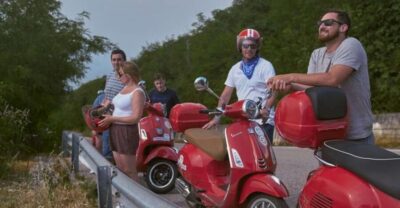
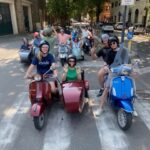
A vintage Vespa makes Rome feel playable. This 3-hour ride lines you up with major landmarks and lesser-visited corners that cars just don’t love, all while you get live facts from a licensed guide in English, Spanish, or Italian. It’s the kind of route where history isn’t read off a sign—you hear it in real time as you glide from spot to spot.
I especially like two things: the stop-by-stop sightseeing keeps the pace moving without turning into a museum slog, and the real draw is the guide’s storytelling—one guide named Erion is repeatedly praised for showing off off-the-beaten-street angles and favorites. The only drawback to consider is that you’re on a scooter for a good chunk of the tour, so you’ll want to dress for wind/road noise and be comfortable moving through busy central Rome.
In This Review
- Key things to know before you go
- Why a vintage Vespa works so well in Rome
- Meeting at Piazza di Pasquino and how the 3-hour loop flows
- Pantheon stop: what to notice in those 20 minutes
- Piazza del Popolo: people’s square with a clear story
- Piazza Navona: ancient stadium scale in a 20-minute pause
- Fontana di Trevi plus Campo de’ Fiori: baroque drama and market life
- Piazza di Spagna and Piramide Cestia: the romantic stairway and the surprise pyramid
- Piazza Venezia, Circo Massimo, and the big-scale switch you feel
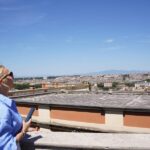
- Terrazza del Gianicolo for views, and why Rome’s west side matters
- Trastevere streets: the character shift across the Tiber
- St. Peter’s Basilica area: the square’s geometry and why it hits
- Colosseum stop: listening to the structure in 20 minutes
- What the $177.44 price buys you (and where it’s a bargain)
- Who this vintage Vespa tour is for
- Should you book this vintage Vespa adventure in Rome?
- FAQ
- How long is the vintage Vespa adventure in Rome?
- What does the tour cost per person?
- What languages are offered for live guidance?
- Where do we meet, and where does the tour end?
- Is this a private tour?
- What’s included in the tour price?
- Are admission tickets required for the stops?
- What if the weather is poor or I need to cancel?
Key things to know before you go
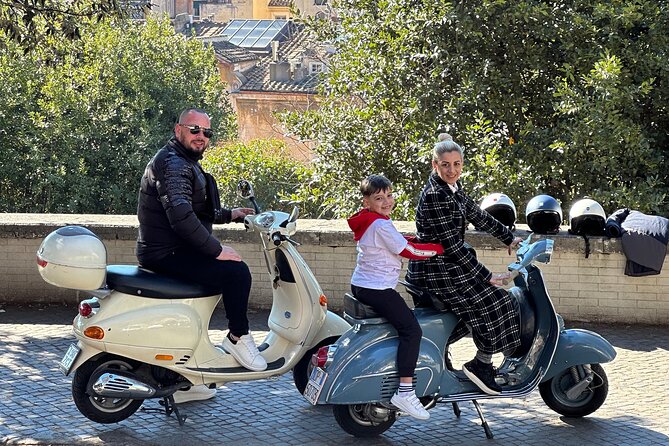
- Vintage Vespa for narrow streets: perfect for getting around areas where buses and cars feel awkward.
- Licensed guide talks live: you choose English, Spanish, or Italian for on-the-fly context.
- Short, efficient landmark stops: most stops are 10–20 minutes, so you’ll see more than you’d expect in 3 hours.
- Free admission at the main stops listed: you won’t be hunting tickets at each stop.
- Included snack + soda: small break energy so the ride stays fun, not frantic.
Why a vintage Vespa works so well in Rome
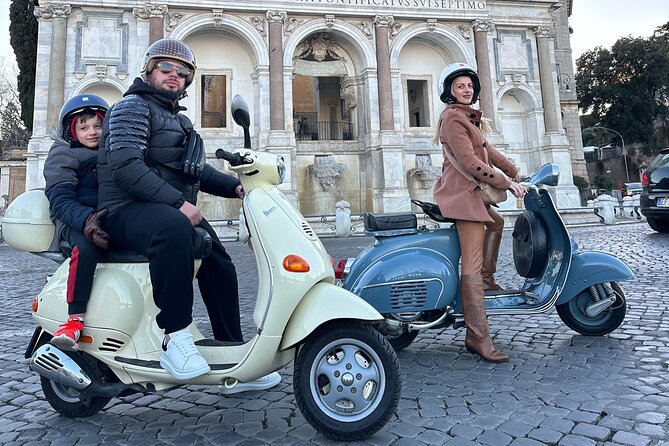
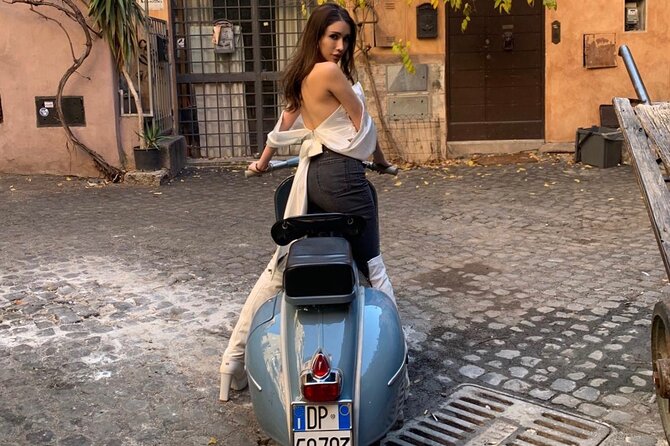
Rome is one of those cities where looking up from the right angle changes everything. From a Vespa, you’re positioned to notice details you’d miss if you were squeezing through crowds on foot—doorways, small piazzas, and street-level views that make the city feel lived-in.
And because the Vespa route is built around tight lanes, it fits the city’s actual shape. Rome isn’t a tidy grid; it’s layers. On two wheels, you can move between those layers quickly, without losing your whole morning to traffic jams.
I also like that the experience is built for real-time learning. Instead of reading a few paragraphs and moving on, your guide tells you why each place matters while you’re already seeing it. One review highlights how Erion’s style mixes practical directions with stories that keep you paying attention.
Meeting at Piazza di Pasquino and how the 3-hour loop flows
You start at Piazza di Pasquino, 1, 00186 Roma RM, Italy and end back at the same meeting point. The tour runs about 3 hours, and it’s private—so it’s just your group, not a giant group with mixed energy levels.
Expect the flow to feel like “ride, pause, look, listen.” Most stops are timed in the 10–20 minute range, which is great when you don’t want to spend half your day waiting. You’ll also have short photo windows, not long wandering breaks, so it helps to decide what you want to capture before you arrive.
This tour is offered with a mobile ticket, and you’ll get confirmation within 48 hours of booking (subject to availability). It’s also listed as near public transportation, so if you’re coming in from elsewhere, you’re not stuck at the far edge of the city.
Pantheon stop: what to notice in those 20 minutes
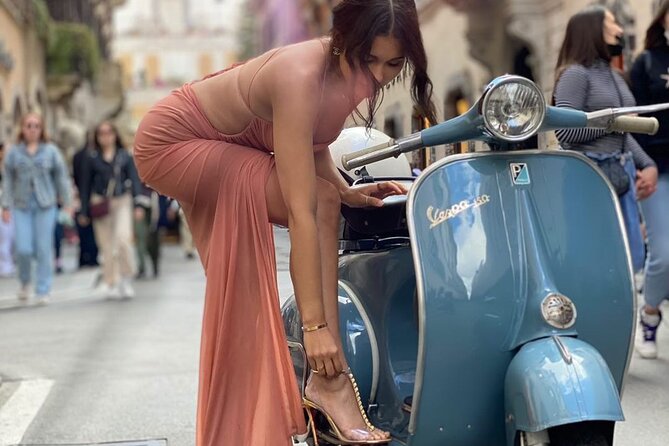
The tour first lands at the Pantheon, one of the best-preserved ancient buildings in Rome. It was completed in 126 AD, and the big moment here is the oculus—the open circle at the top that acts as the building’s main light source.
In a 20-minute stop, the trick is to focus. Look up first, then come down to the details—because the dome and the opening change how the whole building feels. This is also one of the stops where the guide’s timing matters: they can help you understand what you’re seeing without you needing to turn your trip into a reading assignment.
Admission is listed as free for this stop, which is a nice relief. It means you can spend your mental energy on what’s in front of you, not on ticket logistics.
Piazza del Popolo: people’s square with a clear story
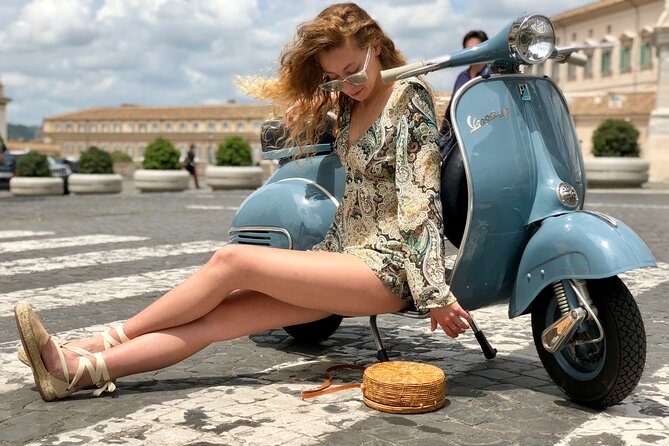
Next up is Piazza del Popolo, often described as Rome’s People’s Square (that’s the modern meaning), with the name connected to poplars (populus in Latin, pioppo in Italian). It’s a large urban square, so it works as a “reset moment” in the middle of moving through dense streets.
In just 10 minutes, you’ll mainly get orientation—what opens up around you and why this area was important. This is one of the places where a quick guide explanation can make the space feel less random.
Admission is listed as free here too, which keeps the tour’s “see more for less stress” vibe going.
Piazza Navona: ancient stadium scale in a 20-minute pause
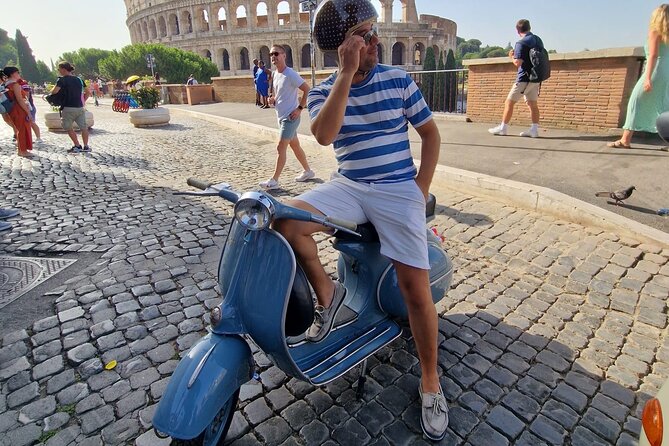
At Piazza Navona, your guide connects the modern square to ancient Rome. In ancient times, it was the Stadium of Domitian, built in 85 and later restored in the 3rd century. The size is the part that lands: about 265 meters long by 106 meters wide, with capacity estimated at 30,000 spectators.
If you’ve seen big public spaces in other cities, this one works because it’s still “stadium-ish.” Even if the seating is gone, the shape gives you a sense of scale. In 20 minutes, you can look at the layout and let the guide’s story put you back in the timeline.
Admission is listed as free, and this is a classic photo spot—but it’s also a great stop to listen, since the ancient-to-modern connection is what makes it worthwhile.
Fontana di Trevi plus Campo de’ Fiori: baroque drama and market life
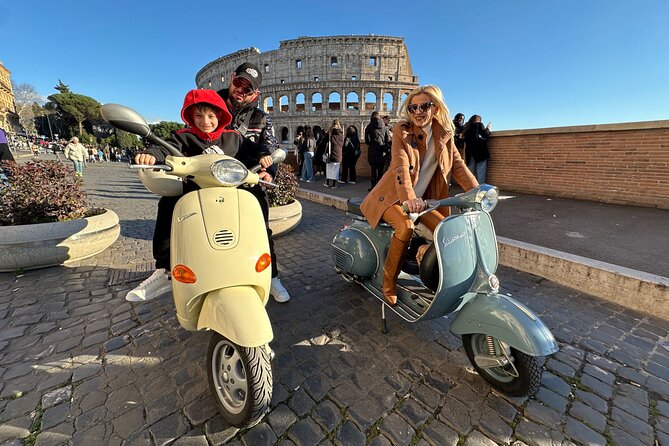
The tour hits Fontana di Trevi with the kind of attention it usually deserves. This fountain is 18th-century, designed by Nicola Salvi and completed in 1762 by Giuseppe Pannini (with additional contributors mentioned). It’s also huge for what you get: about 26.3 meters high and 49.15 meters wide, and it’s described as the largest Baroque fountain in Rome.
Then you move to Campo de’ Fiori, a square between Piazza Navona and Piazza Farnese. During the day, it’s known for a characteristic market vibe with wooden stalls where you can find fresh produce and goods. But the stop also comes with a darker thread in the story: it’s associated with historical executions, including the burning of Giordano Bruno in 1600.
I like that this pairing gives you contrast. Trevi is spectacle. Campo de’ Fiori is everyday life plus serious history. With 15 minutes at each stop, you’ll get enough time for photos and a quick understanding of what you’re looking at—without losing the ride momentum.
Both stops list free admission.
Piazza di Spagna and Piramide Cestia: the romantic stairway and the surprise pyramid
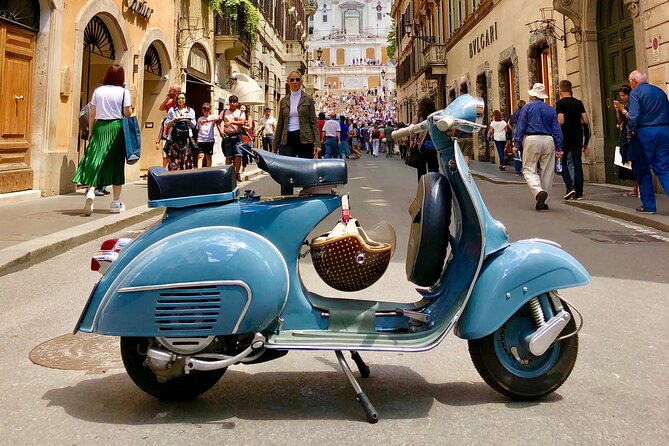
Next is Piazza di Spagna, best known for the Spanish Steps. The staircase climbs between Piazza di Spagna at the base and Trinità dei Monti at the top, with 135 steps called out in the description. It’s also tied to the Bourbon kings of France and their patronage, plus the church of Trinità dei Monti and the Spanish Embassy to the Holy See.
Fifteen minutes here is enough to take in the geometry and get photos from the right spots if you’re paying attention to where foot traffic funnels. This is also a good moment to slow down your eyes—Rome’s staircases and terraces can trick you into thinking they’re all similar. Your guide can help you see what’s unique.
After that comes Piramide Cestia—an ancient Roman pyramid near Porta San Paolo and the Protestant Cemetery. It was built as a tomb for Gaius Cestius and is described as being in a style inspired by Nubian pyramids. The tour notes that it’s unusually well preserved because it was incorporated into Rome’s fortifications.
Fifteen minutes at Cestius is the right length for this kind of stop. You’re not trying to “tour” the pyramid. You’re noticing it, placing it in the city, and letting the guide explain how it fits into Rome’s road history.
Both stops list free admission.
Piazza Venezia, Circo Massimo, and the big-scale switch you feel
The route then connects you to the area around Piazza Venezia. This is where the city’s later monumental ambition shows up. Piazza Venezia’s shape was remade at the turn of the 19th and 20th centuries for construction of the Monumento a Vittorio Emanuele II, also known as Altare della Patria. The monument began in 1885 and finished in 1911, with architect Giuseppe Sacconi as the starter and other names listed for completion work.
You’ll also hear the purpose behind the grand scale. The description points out an ascending pathway via stairways and terraces, culminating in a colonnaded portico with bronze chariots and allegories. And in the crypt, the Unknown Soldier is buried.
Even if you’re not a monument person, this stop helps you understand Rome isn’t just ancient stone. It’s a city constantly reworking what it means to remember.
Then you head to Circo Massimo, Rome’s ancient chariot-racing stadium and mass entertainment venue. It’s placed between the Aventine and Palatine hills and is described as the first and largest of its kind in ancient Rome. The scale here is dramatic—about 621 meters long and 118 meters wide, with capacity over 150,000 in its fully developed form.
The tour gives about 10 minutes here, so your best move is to think “shape and scale,” not “archaeology deep dive.” This is also a spot where the guide can explain how the venue became a model across the Roman Empire.
Both are listed as free for admission.
Terrazza del Gianicolo for views, and why Rome’s west side matters
Next comes Terrazza del Gianicolo—linked to the Janiculum Hill. The tour notes that Janiculum is the second-tallest hill in contemporary Rome, and it sits west of the Tiber, outside the ancient city boundaries. That “outside the old fence” detail matters because it helps explain why Rome’s geography feels different across the river.
There’s also a Fontana dell’Acqua Paola, a Baroque fountain built by Pope Paul V in the late 17th century. This is a useful stop because it gives your brain a break from landmark density. After a sequence of big sights, a viewpoint makes the city feel readable.
The tour lists 20 minutes here. That’s enough time to take in a view and still keep the tour pace in line.
Admission is listed as free.
Trastevere streets: the character shift across the Tiber
The tour includes time in the Trastevere area. The description sets up why the area developed a distinct feel: in Rome’s Regal period, the land across the Tiber was associated with the Etruscans, and Romans controlled the area mostly for river access. It also notes that the connection between Trastevere and the rest of the city used to be a small wooden bridge called the Pons Sublicius.
Today, Trastevere’s character comes from narrow cobbled streets lined with ancient houses. The notes also mention that at night, locals and tourists head to the area’s pubs and restaurants, though much of the original character remains.
Since the tour is about 3 hours, your experience of Trastevere may depend on timing. Still, even without a late-night scene, the street texture is the whole point. You’ll feel the shift from grand monuments to an older, more everyday Rome vibe.
St. Peter’s Basilica area: the square’s geometry and why it hits
The route then goes to the area outside St. Peter’s Basilica, including Saint Peter’s Square in Vatican City. The description calls out key features: the Vatican obelisk at the center, and Bernini’s later redesign with massive Doric colonnades that embrace visitors.
If you’ve only ever seen this place from photos, the real experience is scale and framing. The colonnades act like a built-in stage set. Even a short stop can make the space feel theatrical because your view is guided by design.
The tour lists about 15 minutes here, and admission is free. This is another place where a guide’s explanation changes your attention—from “big church” to “big geometry with intention.”
Colosseum stop: listening to the structure in 20 minutes
Finally, the tour reaches the Colosseum, the massive elliptical amphitheater east of the Roman Forum. The description gives the construction timeline: construction began under Emperor Vespasian in 72 and completed in 80 under Titus. It also mentions later modifications under Domitian, linking the site to the Flavian dynasty.
Your time here is about 20 minutes, so again, think focused viewing. Let the guide explain the timeline and the building’s role. The Colosseum can feel like an icon you already “know,” but hearing how it was built and modified makes it feel more concrete.
Admission is listed as free in the tour description, which is helpful if you’re trying to keep costs down while still seeing the essentials.
What the $177.44 price buys you (and where it’s a bargain)
At $177.44 per person for about 3 hours, this is priced like a focused, guided activity—not a long bus tour with lots of waiting. What makes it feel reasonable is what you get in the bundle.
You’re paying for:
- A licensed guide with live narration (English, Spanish, Italian options listed).
- A private format where it’s only your group.
- Snacks and soda/pop included.
- A routing plan that hits major landmarks plus historic corners you wouldn’t easily reach by car.
And you’re not paying for admission at the listed stops, since the tour description marks ticketing as free for each major stop named. That combination—guide + vehicle experience + snacks + multiple free stops—adds up faster than it looks at first glance.
Dinner isn’t included, so plan to eat after. If you like to keep a loose budget, this tour fits nicely because it covers a lot of the “must-see” without pushing extra fees at every stop.
Who this vintage Vespa tour is for
This works best if you want to see Rome with motion. If you hate long museum lines, and you’d rather keep your day moving, the Vespa format fits your style.
It’s also a strong choice if you enjoy stories you can hear while you’re actively looking at the place. One review praises how Erion shows hidden alleyways and favorites, and that kind of guide personality matters on a tour like this where you’re not spending a long time at any single site.
You should consider a different option if scooter riding sounds stressful for you, or if you’re the type who needs very long stops. This tour is efficient by design.
Should you book this vintage Vespa adventure in Rome?
If your goal is a fast, fun, guide-led sweep of Rome’s top sights plus a few off-to-the-side moments, I think it’s a solid book. The price makes more sense once you factor in the licensed guide, the private feel, and the included snacks and soda, especially with free admission marked at the main stops.
Just be honest with yourself about the ride component. If you want Rome at a relaxed walking pace with long hangs in each piazza, this may feel too time-tight. But if you want to feel the city—moving through it like locals do for short stretches—then this is one of the more practical ways to do it in a few hours.
FAQ
How long is the vintage Vespa adventure in Rome?
The tour is about 3 hours (approx.).
What does the tour cost per person?
The price is $177.44 per person.
What languages are offered for live guidance?
The guide provides live guidance in English, Spanish, or Italian.
Where do we meet, and where does the tour end?
You meet at Piazza di Pasquino, 1, 00186 Roma RM, Italy, and the tour ends back at the meeting point.
Is this a private tour?
Yes. It’s listed as private, so only your group will participate.
What’s included in the tour price?
It includes snacks, soda/pop, and a licensed guide. The guide is available in English, Spanish, or Italian.
Are admission tickets required for the stops?
The tour description lists admission tickets as free for the stops included.
What if the weather is poor or I need to cancel?
This experience requires good weather. If it’s canceled due to poor weather, you’ll be offered a different date or a full refund. Cancellation is free if you cancel up to 24 hours in advance for a full refund.