REVIEW · SIENA
Private Vespa Tour in Chianti
Book on Viator →Operated by Tuscany Private Tour · Bookable on Viator
Chianti on a Vespa feels like cheating. This private 5-hour tour pairs countryside riding with your choice of villages and viewpoints, then ends with an Italian lunch and wine tasting. The trade-off: you need scooter or motorbike experience and a valid driving license, and staff will only put you on a Vespa if they feel you’re comfortable.
What makes it work is the mix of time on the road and time on foot. You stop in places like Radda in Chianti and Panzano in Chianti, and guides such as Tommasso, Martina, and Stefani bring the towns to life with history you can actually place in the scenery and streets.
If you’re expecting a slow, sightseeing-bus day, this isn’t that. It’s a hands-on ride, and the better you are at reading the road and handling a scooter confidently, the more the day will feel like your own.
In This Review
- Key points to know before you go
- Your 5-hour Chianti Vespa day starts in Castellina in Chianti
- Safety and scooter skill check: how your Vespa is decided
- Radda in Chianti: a hill town with deep roots
- Panzano in Chianti: Etruscans, Florentines, and a fortified past
- Castellina in Chianti area: Etruscan tombs and fortification walls you can feel
- Lunch and wine tasting: where the day slows down
- Private means your pace: choosing villages and viewpoints
- Who this tour suits best (and who should skip it)
- Value for money: why the private format can make sense
- Practical tips to make the day smoother
- Should you book this private Vespa tour in Chianti?
- FAQ
- How long is the private Vespa tour in Chianti?
- Where does the tour start and end?
- What language is the tour offered in?
- Do I need scooter or motorbike experience and a license?
- What happens if I’m not comfortable riding a Vespa?
- Which stops are included during the tour?
- Is the tour really private?
- Is admission included for the stops?
- Is cancellation free?
Key points to know before you go
- Private pacing with stops and viewpoints picked for your group
- Radda in Chianti for medieval significance and hilltop atmosphere
- Panzano in Chianti for Etruscan and Roman roots tied to today’s town
- Castellina in Chianti area including Etruscan sites like Montecalvario and the Necropoli del Poggino
- Italian lunch plus wine tasting built into the day
- English tour available with staff who check scooter skills before you ride
Your 5-hour Chianti Vespa day starts in Castellina in Chianti
The tour begins and ends back where you meet: Tuscany Private Tour, Via, Viale IV Novembre, 35, 53011 Castellina in Chianti SI, Italy. It starts at 10:00 am, so you get a full morning push of light and views without spending the whole day driving around. The total time is about 5 hours, which is long enough to feel like you’ve covered ground, but not so long that you’ll lose momentum.
This is also a big clue about how you should plan your day. If you’re staying in or near Castellina (or you’re willing to base yourself there), you avoid the extra hassle of long transfers. And since the tour ends back at the meeting point, you don’t need to coordinate your own pickup later.
Safety and scooter skill check: how your Vespa is decided
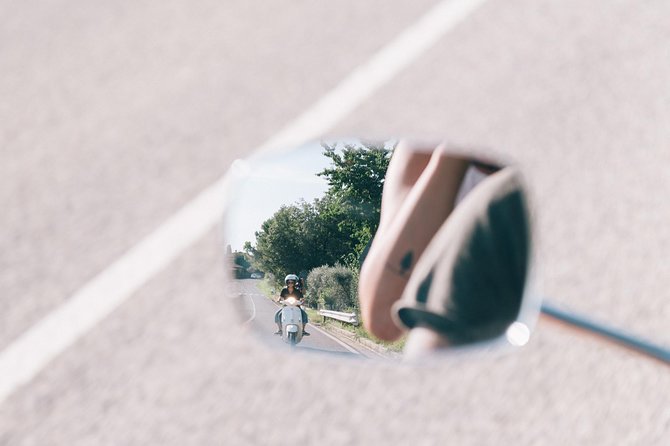
This tour requires scooter or motorbike experience, with a minimum driving age of 18 and a driving license requested. Before you roll out, there’s a briefing with staff who evaluate your skills. If they decide you shouldn’t rent a Vespa, they’ll start you on a different vehicle based on availability, and that decision is final.
That matters because it shifts the day from a casual ride to a guided equipment experience. You’re not just showing up and hoping for the best. Bring a calm, practical attitude. If you can handle a scooter smoothly—starting, stopping, and holding a steady line—you’ll get the full Vespa experience the highlights promise.
Also, remember this is a private tour. That’s great for comfort and pace, but it also means staff are watching you closely to make sure everyone stays safe.
Radda in Chianti: a hill town with deep roots
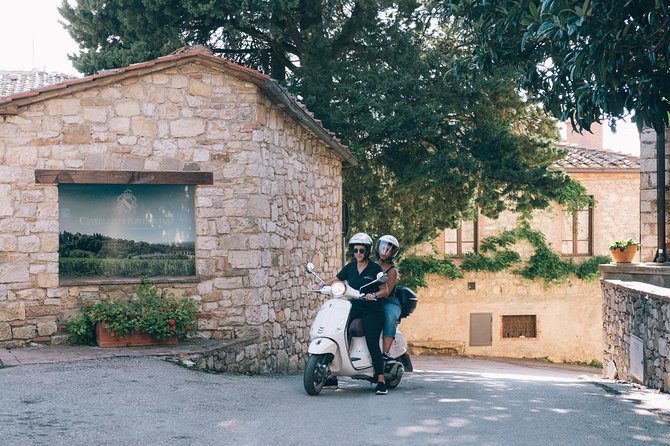
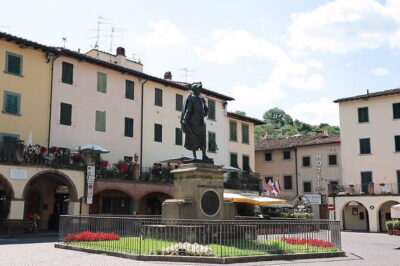
One of the core stops is Radda in Chianti. Time here is set at about 45 minutes, which is short but enough to get the feel of the town and its surroundings. Radda isn’t just a pretty dot on a map. The area around it has evidence of human presence going back to ancient times, including the archaeological area of Poggio la Croce, where remains of an early village were uncovered.
The story goes even further back. You can make sense of why people chose this terrain over and over: Radda’s region shows Etruscan traces (even if only assumed in places), then small rural agglomerations by the 5th century as the Western Roman Empire fell. Later, feudal society shaped the villages between the 9th and 10th centuries, when settlements were built and expanded.
What I like about stopping here is that you’re not stuck in a single time period. The town gives you a way to connect the dots: early habitation, medieval documents, and the constant tug-of-war between powers that shaped Chianti. You can also sense why wine later became so central here. In the 1600s, castles transformed into stately villas, and owners turned to wine production.
If you’re the type who enjoys seeing how today’s streets fit into older layers, Radda is a strong choice. One practical note: 45 minutes means you’ll want to move efficiently, listen to your guide, and save slower exploring for later if you want it.
Panzano in Chianti: Etruscans, Florentines, and a fortified past
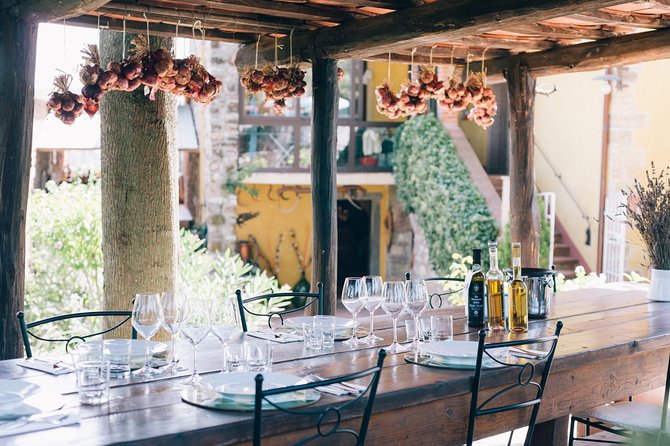
Your second major stop is Panzano in Chianti, with about 20 minutes scheduled. That’s not a lot of time, so your success here depends on paying attention to what your guide points out. Panzano’s area was inhabited in Etruscan times, supported by discoveries like a stele from the 6th to 5th century BC connected to the church of San Leolino.
In Roman times, the area seems to have been densely occupied, and that continuity shows up in place names, including Panzano itself. By the early 10th century, a parish church of San Leolino in Flacciano is mentioned, and later that religious center becomes tied directly to Panzano.
Then the medieval era takes over. In the 12th century, written testimony of the name appears, and by the 13th century, the church of Santa Maria placed in the castle is mentioned. The castle was already developed before the 12th century and tied to families such as the Firidolfi.
Here’s the part that makes a quick stop feel meaningful: Panzano wasn’t just a peaceful hill town. It was sacked in the aftermath of conflict between Florence and rival forces, including damage connected to the Battle of Montaperti. Later, it was occupied and sacked again during wars involving Florence and Milan’s Visconti.
By 1478, during another wave of invasions in Chianti, the castle of Panzano became a key defensive bulwark for Florence and even the seat of a commissioner of the republic after the Sienese and allied troops invaded. For a town you might assume is only about wine, that defensive past adds texture fast.
Castellina in Chianti area: Etruscan tombs and fortification walls you can feel
The itinerary also includes the Castellina in Chianti area and the surrounding sites tied to Etruscan presence and later medieval fortifications. Montecalvario is one highlight: an Etruscan tomb near town dated to the 7th to 6th century BC. Another is the Necropoli del Poggino near Fonterutoli, which further supports the idea of an established Etruscan presence.
If you like context that makes a stop more than a photo, this is where you’ll feel it. The excavations around Castellina indicate there was likely a large town, with the inhabited center believed to be located at Salinvolpe, just a few hundred meters from today’s Castellina. Even without huge visible remnants everywhere, the logic of settlement patterns becomes clearer when you stand near the sites.
After the Etruscans, the medieval record starts to guide the story. In the 11th century, the area is described as a fief connected with nobles of the Castello del Trebbio, a family linked to the Counts Guidi. By the 12th century, Castellina came under Florence’s influence, and an agreement in 1193 allowed Florentines to militarily preside over certain castles, with Castellina among them.
One reason Castellina mattered is geography. It sat on a direct road that connected rival cities, which made it a strategic outpost. In the 14th century, it became part of the Lega del Chianti and even served as the head of one of its divisions, the Terziere di Castellina, managing the area sloping toward Valdelsa.
Fortification is the thread you’ll notice if your guide points it out. Castellina was sacked and burned in 1397 by troops connected to Gian Galeazzo Visconti and Alberico da Barbiano. After that, fortifying the area became a priority. The records include the instruction that a fortification should be built on-site. Construction moved in stages, and workers from the Opera del Duomo were commissioned to fortify Castellina along with other locations. Even figures tied to major projects in Florence show up in this story, including Filippo Brunelleschi being sent to establish intervention types and estimate costs.
The later conflicts were harsh. Aragonese assault in 1452 is described as resisted, but in 1478 Castellina was conquered during the second Aragonese invasion of Chianti by Sienese and Neapolitan troops. The defense was personally directed by Giuliano da Sangallo, while Francesco di Giorgio Martini is mentioned as commanding the besiegers. Then control shifted again, with the Florentines resuming it in 1483.
You don’t need to memorize names to appreciate what’s going on. You just need to notice that the town’s shape and surviving structures likely reflect centuries of defense and redefinition.
Lunch and wine tasting: where the day slows down
The highlights promise an Italian lunch and wine tasting, and that’s the best kind of payoff at the end of a ride. After time on scooters and short walks, food gives you a clean reset. It’s also a practical choice: you don’t have to hunt for a meal while your group is still fueled by motion and fresh air.
Wine tasting fits naturally here because Chianti isn’t a single flavor. It’s tied to the hills, the villages, and the long history of production—exactly the themes you’re seeing as you stop at Radda, Panzano, and the Castellina area. If the day feels like it’s moving fast, the lunch and tasting are what turn it into a full experience rather than just a sightseeing run.
I like that the tour builds this in instead of leaving it to chance. Your time with the guide ends with a shared moment, which tends to make the stories land.
Private means your pace: choosing villages and viewpoints
This is a private tour, meaning only your group participates. That changes everything about the experience. Instead of following a set script with strangers, you can stop at villages and viewpoints of your choosing, within what’s practical for the day.
The Vespa part matters here. On a scooter, you don’t just see Chianti from a distance. You move through it. That motion makes small detours feel worthwhile and makes viewpoints feel immediate rather than staged.
The reviews back up this value in a very practical way. I’ve seen how guides like Tommasso lead personal tours on foot after riding, with clear passion for history that you can connect to what you’re standing in front of. Another set of reviews mentions Martina and Stefani taking people through beautiful countryside and into small towns for history and views that actually match the ride.
If your group wants a mix of quick stops and slower conversations, private format helps. If you prefer maximum structure and zero decisions, you might find the ability to choose slows you down. But if you like having control, this is your kind of day.
Who this tour suits best (and who should skip it)
This private Vespa tour is best for people who:
- Are comfortable riding a scooter or motorbike and want the freedom of a small, guided route
- Want Chianti with history you can place in real locations, not just dates on a page
- Appreciate an itinerary that includes both movement and walking, plus a real payoff meal
It may be less ideal for people who:
- Don’t have scooter experience or aren’t confident with motorbike handling, since staff evaluate skills and may assign a different vehicle
- Want a low-effort, fully car-based day with minimal physical movement
- Are prone to motion fatigue, since the day includes riding time on winding countryside roads
If you’re traveling as a couple, a small group of friends, or a family where the drivers are ready for scooters, the private setup is a real benefit.
Value for money: why the private format can make sense
There’s no price listed here, so I can’t tell you whether it’s cheap or expensive in your specific market. But I can tell you how to judge value.
You’re paying for three things that matter:
- Private guiding and routing (only your group, plus the option to pick villages and viewpoints)
- A Vespa-based way to cover Chianti quickly without losing the feel of the countryside
- Lunch and wine tasting bundled into the experience, so you’re not piecing together meals and stops on your own
Compared with tours that feel like a checklist, a private format can save time and reduce friction. You don’t have to negotiate what matters to you with a large group. You also don’t spend your whole day deciding where to eat.
The hidden value is the guide time. When a guide like Tommasso can pair riding with on-foot explanations, you get more meaning per minute than you’d get from a purely self-guided drive.
Practical tips to make the day smoother
A few smart moves will help your day feel effortless:
- Wear clothes you’re fine riding in for a few hours. Layers help because hillside weather can shift.
- Have your driving documents ready. The tour requests a driving license, and you need to meet the 18+ driving rule.
- Be honest during the skills briefing. Staff are evaluating you for safe Vespa renting.
- If you’re prone to getting cold or sunburned, plan for both. Hill towns can mean strong light even if the morning feels mild.
- Use the short stop times wisely. In Radda and Panzano, your window is limited, so listen for what your guide points out and move at their suggested pace.
If you treat the ride like part of the experience (not just transportation), you’ll enjoy the day more.
Should you book this private Vespa tour in Chianti?
Book it if you want a private Chianti experience that mixes scooter riding, short meaningful town stops, and an end-of-day Italian lunch plus wine tasting. This is a good fit for drivers who already feel comfortable on scooters and for groups that like choosing viewpoints rather than following a rigid script.
Skip it if you want a totally car-based, low-activity tour, or if you’re not confident riding. The staff skills evaluation is real, and it can change the vehicle you ride.
If you’re already in the Castellina area and you like the idea of combining ancient sites, medieval fortification stories, and wine culture in one smooth 5-hour day, this is the kind of tour that earns its spot on your itinerary.
FAQ
How long is the private Vespa tour in Chianti?
The tour lasts about 5 hours.
Where does the tour start and end?
It starts at Tuscany Private Tour, Via, Viale IV Novembre, 35, 53011 Castellina in Chianti SI, Italy, and ends back at the same meeting point.
What language is the tour offered in?
The tour is offered in English.
Do I need scooter or motorbike experience and a license?
Yes. You need experience with scooters or motorbikes. The minimum age for driving is 18, and a driving license is requested.
What happens if I’m not comfortable riding a Vespa?
A staff member will brief you and evaluate your skills. They will decide whether you can rent the Vespas, and if not, the tour will start with a different vehicle based on availability.
Which stops are included during the tour?
You’ll visit Radda in Chianti and Panzano in Chianti, plus the Castellina area sites connected to Montecalvario and the Necropoli del Poggino.
Is the tour really private?
Yes. This is a private tour/activity, and only your group participates.
Is admission included for the stops?
The information provided indicates admission tickets are free for stops listed with entry time, including a 45-minute Radda in Chianti stop and a 20-minute Panzano in Chianti stop.
Is cancellation free?
Yes. You can cancel for a full refund up to 24 hours in advance of the experience start time.